
A homemade conditioner with coconut oil, aloe vera & jojoba oil
If you love the idea of making some of your everyday beauty products yourself, this homemade hair conditioner is a fun one to experiment with.
The formula combines coconut oil, BTMS-50, glycerine, jojoba oil and aloe vera gel, with Vitamin E and essential oils as optional additions.
The result is designed to be a rich, creamy conditioner with a beautiful botanical feel — exactly the kind of little bathroom DIY that fits our Little DIY Luxuries series. 🤎
Want to make this DIY?
Find the ingredients and supplies for this homemade conditioner in the PrettyThingsClub Little DIY Luxuries Benable collection. 🤎
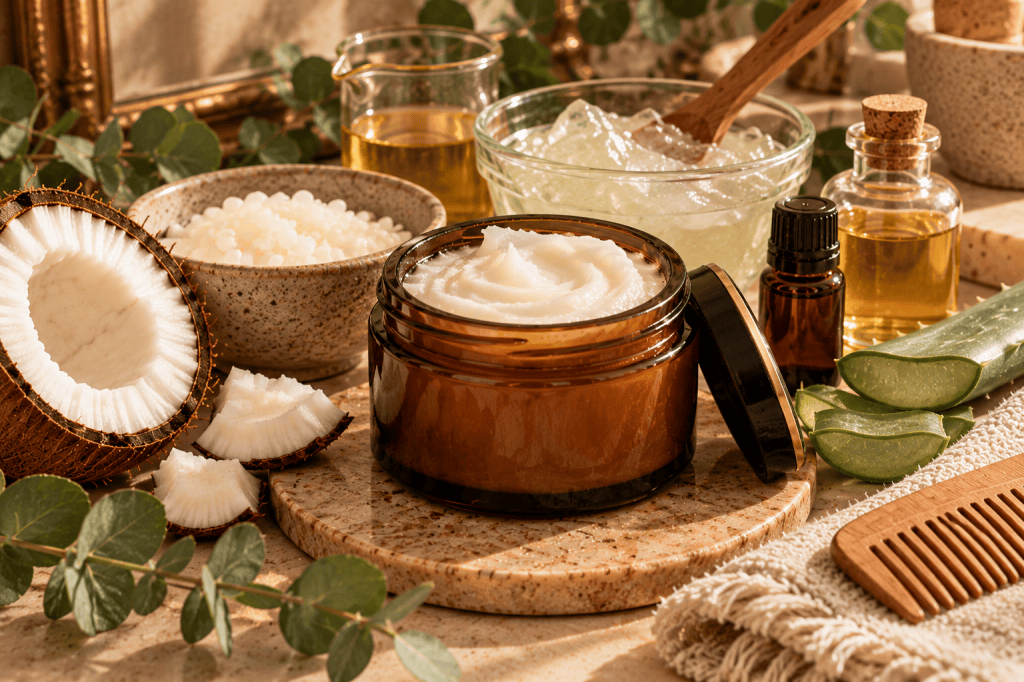
What you’ll need
- ¼ cup coconut oil
- 50 g BTMS-50
- ⅛ cup glycerine
- ⅛ cup jojoba oil
- 1 cup aloe vera gel
- Vitamin E — a small amount
- Essential oil — optional, for fragrance
You’ll also need:
- A heat-safe glass container
- A pot for creating a gentle water bath
- A wooden spoon
- A clean container for your finished conditioner
How to Make It
01 — Melt the coconut oil & BTMS-50
Place your coconut oil and BTMS-50 into a heat-safe glass container.
Put the glass container into a pot of water to create a gentle water bath and heat until the ingredients have completely melted.
Stir with a wooden spoon as they melt.
BTMS-50 is a conditioning emulsifier, so it needs to be properly melted before you move on to the next stage. Formulation guidance generally recommends heating it sufficiently to fully melt it.
02 — Add the glycerine & jojoba oil
Once the coconut oil and BTMS-50 have melted together, add:
⅛ cup glycerine
⅛ cup jojoba oil
Mix everything well.
The mixture should become smooth and evenly combined.
03 — Add the aloe vera gel
Next, add:
1 cup aloe vera gel
Mix thoroughly until everything is incorporated.
This is where the mixture starts to take on more of a creamy conditioner consistency.
04 — Add Vitamin E
Once the mixture has cooled sufficiently, add a small amount of Vitamin E.
Your very scientific measurement can be:
a little spritzer on the bigger side 😂
For the actual formulation, however, follow the usage instructions for the specific Vitamin E product you’re using.
One important distinction: Vitamin E is an antioxidant, not a preservative. It can help with oxidation of oils, but it does not replace a broad-spectrum preservative in a water-containing conditioner.
05 — Add your fragrance
If you’d like your conditioner to smell beautiful, you can add an appropriate cosmetic fragrance or essential oil.
Vanilla-inspired fragrance would be lovely for the PrettyThingsClub version. 🤎
For essential oils, use only products intended for cosmetic use and follow the supplier’s recommended dilution rate. More isn’t necessarily better.
The Important Part: Preservation
This is the part I would not skip with this recipe.
Because we’re adding aloe vera gel and other water-containing ingredients, this is no longer an anhydrous oil-based DIY. Microorganisms can grow in water-containing cosmetic products, particularly products repeatedly opened and used in a warm, humid bathroom.
The European Commission specifically identifies shampoos and conditioners as products with increased contamination risk because water can be introduced during repeated use.
So don’t assume that Vitamin E, essential oils or refrigeration will preserve this conditioner.
For a formulation intended to be stored and repeatedly used, you’d want an appropriate broad-spectrum cosmetic preservative compatible with the complete formula, together with appropriate pH and stability considerations. Properly formulated water-based cosmetics also need appropriate preservation/testing rather than relying on appearance or smell to determine whether they’re safe.
Final Note
I love these little DIYs because they make ordinary routines feel more intentional.
But homemade doesn’t automatically mean safer, better or more effective. With personal-care products, the formulation matters just as much as the ingredient list.
This conditioner is a fun formulation to experiment with, but because it contains water-based ingredients, I wouldn’t recommend treating the recipe as a shelf-stable commercial conditioner without adding an appropriate preservative system and doing proper formulation/stability testing.
That’s actually a good philosophy for the whole Little DIY Luxuries series:
beautiful, approachable and genuinely useful — without pretending that “homemade” automatically means risk-free. 🤎
🛍️ Shop the DIY
Affiliate disclosure: Some links may be affiliate links, which means PrettyThingsClub may earn a commission at no extra cost to you.


